

The At-Home Laser Device Market is estimated to be valued at USD 0.6 billion in 2025 and is projected to reach USD 1.5 billion by 2035, registering a compound annual growth rate (CAGR) of 10.0% over the forecast period.
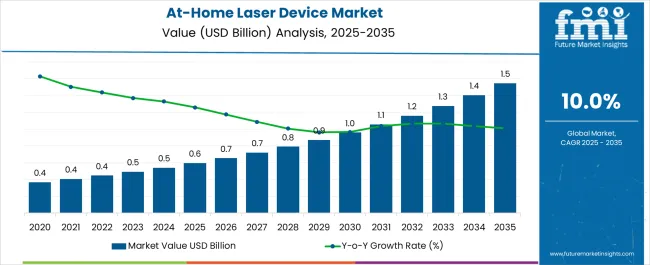
| Metric | Value |
|---|---|
| At-Home Laser Device Market Estimated Value in (2025 E) | USD 0.6 billion |
| At-Home Laser Device Market Forecast Value in (2035 F) | USD 1.5 billion |
| Forecast CAGR (2025 to 2035) | 10.0% |
The at-home laser device market is expanding at a strong pace. Growth is being fueled by rising consumer focus on personal grooming, increased demand for convenient skincare solutions, and the availability of technologically advanced yet user-friendly devices. Current market conditions are shaped by high adoption in developed regions due to disposable income growth and awareness of non-invasive beauty treatments.
Emerging economies are showing rising interest as affordability and product accessibility improve. Manufacturers are concentrating on enhancing safety features, efficacy, and portability, which has reinforced consumer confidence and broadened acceptance across diverse demographics. Regulatory approvals and quality certifications are also playing a key role in driving adoption.
The future outlook remains positive with increasing penetration through online and offline distribution channels, coupled with rising influence of digital marketing Growth rationale is further supported by the shift toward self-care and preventive beauty routines, which ensures consistent demand and long-term expansion of the at-home laser device market.
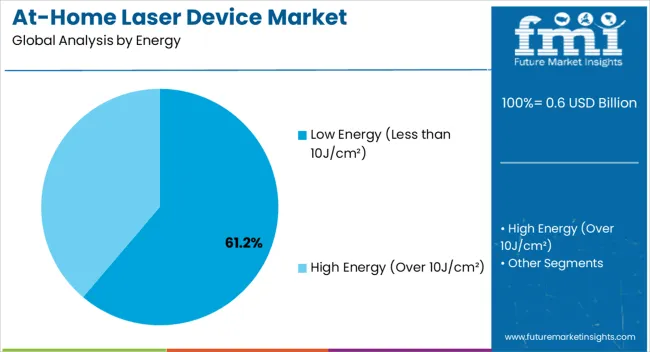
The low energy segment, representing 61.20% of the energy category, has established its dominance due to its high safety profile and suitability for home use. Devices within this segment are widely accepted as they minimize the risk of burns or skin irritation while still providing visible results over repeated sessions. Market leadership is being reinforced by regulatory preferences that favor low-energy designs for consumer safety.
Strong adoption has been observed among first-time users who prefer less intensive treatments with easier usability. Manufacturing advancements in laser modulation and cooling mechanisms have enhanced effectiveness without compromising safety.
Affordability of low-energy devices has further widened accessibility, especially in price-sensitive markets Future growth is expected to be sustained by continued consumer trust, product innovation, and the expansion of e-commerce platforms that simplify availability of low-energy devices across global regions.
Retail pharmacies have maintained their stronghold as a primary distribution channel for at-home laser devices. Their structured presence, consumer trust, and established networks have ensured widespread accessibility of products.
Hospital-grade quality assurance and pharmacist guidance have strengthened purchasing confidence, particularly among first-time buyers. Retail pharmacies are also benefiting from collaborations with leading device manufacturers that prioritize visibility in physical outlets.
While online sales channels are gaining traction, the credibility and convenience associated with pharmacy-based purchases continue to position this channel as a leader in distribution Over the forecast horizon, retail pharmacies are expected to retain a substantial share by expanding product portfolios, offering bundled promotions, and integrating digital engagement strategies to reinforce customer loyalty and broaden reach.
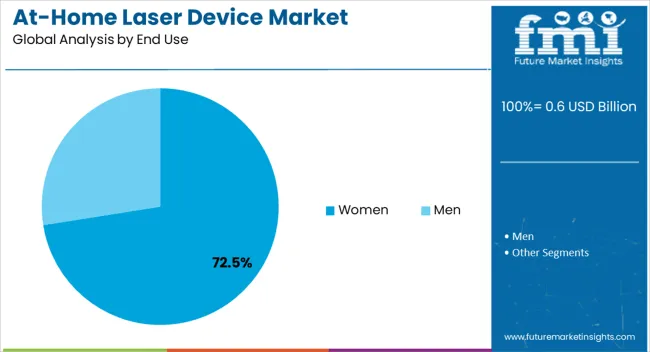
The women’s segment, holding 72.50% of the end use category, has emerged as the dominant consumer base due to higher demand for aesthetic treatments and personal care solutions. Adoption has been driven by growing awareness of advanced beauty technologies and increased disposable income among female consumers in both developed and emerging economies.
Marketing campaigns and brand positioning have strongly targeted women, reinforcing their role as the primary adopters of at-home laser devices. Enhanced safety features, combined with ease of use and effectiveness for common applications such as hair removal and skin rejuvenation, have ensured repeat purchases and long-term loyalty within this segment.
The prominence of women in driving growth is further supported by lifestyle trends prioritizing self-care and convenience Looking ahead, this segment is projected to maintain its dominance, supported by expanding product lines tailored to female users and ongoing brand engagement initiatives.
The market value for the at-home laser device was around 5.1% of the overall USD 0.6 billion global hair removal products market in 2025. The at-home laser device sales expanded at a CAGR of 9.8% from 2020 to 2025, owing to the growing focus on self-care.
The demand for medical equipment is rising in sophistication and technology. Most people prefer having all the amenities readily available, as it saves time and is financially feasible.
Patients are increasingly asking for information and procedures that enhance the look of their skin. Since many of the cutting-edge treatments and products have yet to stand the test of time, the ongoing evolution of dermatology raises questions about safety and effectiveness.
| Attributes | Details |
|---|---|
| Market Value for 2020 | USD 318.6 million |
| Market Value for 2025 | USD 485.5 million |
| Market CAGR from 2020 to 2025 | 9.8% |
For both medicinal and aesthetic purposes, increasing demand for hair reduction methods that are secure, reliable, and efficient has led to an opportunity for the market player to invest in the global laser devices industry. Office-based laser systems have improved epidermal cooling, increased spot sizes and fluencies, and increased repetition rates over the past ten years.
Post-pandemic, women have an increased preference for dermatological and cosmetic procedures that can be carried out at home. This factor may aid in keeping the at-home laser device market attractive in the projected years.
The segmented market analysis of at-home laser device is included in the following subsection. Based on comprehensive studies, the low-energy sector is leading the energy category, and the women segment is commanding the end-use category.
With a share of 76.8% in the global at-home laser equipment market in 2025, low energy (Less than 10J/cm²) is predicted to exhibit strong growth at a CAGR rate of 11.4% by the end of the forecast period.
| Leading Segment | Low Energy (Less than 10J/cm²) |
|---|---|
| Segment CAGR | 11.4% |
| Segment Share | 76.8% |
| Leading Segment | High Energy (Over 10J/cm²) |
|---|---|
| Segment CAGR | 7.3% |
| Segment Share | 23.2% |
The women segment takes the lead, with a share of 74.8% from 2025 to 2035. The segment is projected to witness a CAGR of 9.4% from 2025 to 2035.
| Leading Segment | Women |
|---|---|
| Segment CAGR | 9.4% |
| Segment Share | 74.8% |
| Leading Segment | Men |
|---|---|
| Segment CAGR | 13.9% |
| Segment Share | 25.2% |
The at-home laser device market can be observed in the subsequent tables, which focus on the leading counties. This section pinpoints the countries with enormous opportunities and growth prospects for at-home laser device manufacturers.
| Countries | CAGR |
|---|---|
| United States | 5.7% |
| Australia | 6.9% |
| China | 10.8% |
| India | 11.2% |
| Japan | 6.1% |
The at-home laser device industry in the United States is projected to rise at a stable CAGR of 5.7% through 2035.
Australia's at-home laser device industry anticipates substantial growth with a CAGR of 6.9% through 2035.
The at-home laser device industry in China is forecasted to experience a robust CAGR of 10.8% through 2035.
India's at-home laser device industry is poised for remarkable growth, expecting an impressive CAGR of 11.2% through 2035.
The at-home laser device industry in Japan is set for a steady CAGR of 6.1% through 2035.
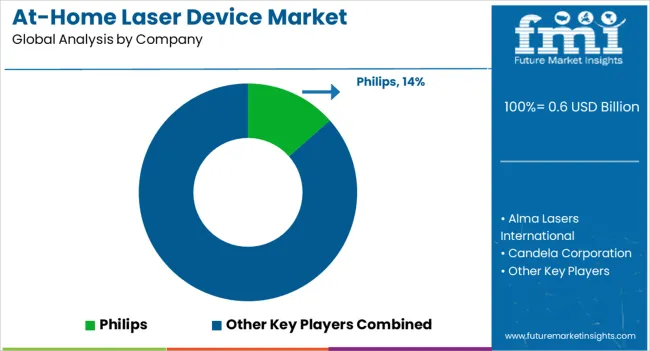
The at-home laser hair removal device market is highly fragmented due to the intense competition in the at-home laser device development industry. The at-home laser device manufacturers are employing partnerships collaborations, and introducing new products to meet customer demand and expand their customer base.
Noteworthy Developments
| Company | Details |
|---|---|
| SmoothSkin | In March 2025, SmoothSkin, the leading IPL (Intense Pulsed Light) hair removal brand, partnered with Target to distribute its products in stores. Customers may now purchase SmoothSkin'sSmoothSkin's IPL hair removal products on Target.com. |
| Candela Corporation | In April 2025, in an innovative commercial partnership, Candela Corporation, the top global manufacturer of medical aesthetic devices, and Merz Aesthetics, the largest specialized medical aesthetics firm in the world, collaborated to offer one of the largest medical aesthetics collections in the world. The partnership shall launch in North America to expand the device, injectable, and skincare portfolios worldwide, giving clients simple access to full product and support service offerings. |
How big is the at-home laser device market in 2025?
The global at-home laser device market is estimated to be valued at USD 0.6 billion in 2025.
What will be the size of at-home laser device market in 2035?
The market size for the at-home laser device market is projected to reach USD 1.5 billion by 2035.
How much will be the at-home laser device market growth between 2025 and 2035?
The at-home laser device market is expected to grow at a 10.0% CAGR between 2025 and 2035.
What are the key product types in the at-home laser device market?
The key product types in at-home laser device market are low energy (less than 10j/cm²) and high energy (over 10j/cm²).
Which distribution channel segment to contribute significant share in the at-home laser device market in 2025?
In terms of distribution channel, retail pharmacies segment to command 0.0% share in the at-home laser device market in 2025.
Full Research Suite comprises of:

Market outlook & trends analysis
Interviews & case studies
Strategic recommendations
Vendor profiles & capabilities analysis
5-year forecasts
8 regions and 60+ country-level data splits
Market segment data splits
12 months of continuous data updates
DELIVERED AS:
PDF EXCEL ONLINE

At-Home Laser Device Market

Thank you!
You will receive an email from our Business Development Manager. Please be sure to check your SPAM/JUNK folder too.

